Showing posts with label essays. Show all posts

Monday, April 8, 2024

Dream Song 4

 Zoe Byszynski

        Dream Song 4 by John Berryman, is narrated by Henry as he tries to contain his lust for a woman who caught his eye at a restaurant. Dream Song 4 is part of a collection of Berryman's larger works (77 Dream Songs and His Toy, His Dream, His Rest) where each dream song consists of three stanzas with six lines per stanza. The narrator, Henry, is a self loathing man and depressed man (loosely autobiographical of Berryman himself). Sir/Mr. Bones is the idiot questioner and voice of reason who speaks with a black dialect as a form of literary minstrelsy. In the first stanza, Henry notices a woman eating dinner with her husband and three other men across the restaurant and he instantly wants to ravish her. In the second stanza, Henry loses hope, but Sir Bones tries to reassure him there's other fish in the sea. In the last stanza, he jealously criticizes the husband next to her, but in response starts criticizing himself for his desires. Berryman uses the external descriptions and internal narration to put Henry's desires at odds with his ability to get them.
        Henry's desire for the woman is based around her mysteriousness and forbiddenness. Notably when the woman glances at him "twice" it's emphasized with its own line showing how important the second glance is to Henry. It's as if he's trying to rationalize that the woman wants him back or else she shouldn't have looked again. Since he knows nothing of her personality, his fixation is with her body. For example, "What wonders is/she sitting on, over there?" draws attention to Henry's imagination. There could be anything between her legs, but the fact that he doesn't know is what fuels his lust. This begs the question, if Henry were alone with the woman fully naked would he still want her anymore?
        Societal rules hold Henry back from getting what he wants. The woman has a husband and they're both in public, which Henry acknowledges, "kept me from springing on her/or falling at her little feet." To that degree, Henry's superego is also what's holding him back. He says, "There ought to be a law against Henry." He's disgusted and disappointed with himself for the mere thought of what he wants to do to the woman. In fact, the poem itself is a Dream Song, suggesting even in dreams Henry can't get what he wants. Although Henry views it as neither of those things, he believes there's just an exterior force preventing him from getting what he wants. As he remarks, "She might as well be on Mars./ Where did it all go wrong?" He thinks the reason he can't get what he wants is due to a fundamental flaw of himself, but fails to realize not getting what you want is universal. Henry's character is a paradox of self loathing and self absorption.
        Thus, Henry's experience of unrequited desire highlights the conditions of longing and superego. Humans desire for what they can't, once they have it it's no longer "desire", Henry believes it's the world preventing him from getting what he wants, it's really himself and that's exactly why he wants it.

Hills Like White Elephants

 Zoe Byszynski

        Hills Like White Elephants by Ernest Hemingway is the story of "the American" and "the girl" on their way to get an abortion. As they drink and wait for the train, the Girl remarks the hills look like White Elephants, which the man can't understand. Hemingway emphasizes the differences in each character's headspace to assert a power dynamic between the two.
The American is a play on the hyper masculine patriarch. He is in control of the conversation, not entertaining the girl's similes of White Elephants or absinthe. He's the first one to bring up the operation, insisting he wouldn't have her go through with the procedure if she doesn't want to, which unfairly puts the responsibility on her shoulders. Yet, he continually tries to convince her that the procedure is simple and safe. Taking place during the early 1920s, abortions were highly taboo, unregulated, dangerous, and in many places illegal/ off the book. The American clearly has no idea what the procedure consists of physically, he uses language like "let the air" in to talk about a complicated relationship, and doesn't even consider how it could be affecting her mentally.
On the other hand, the girl tries to remain nonchalant, yet it's clear she's helpless and confused. The Girl is less assertive in the conversation, trying to distract herself with her surroundings. She repeatedly tells the man that she will do whatever he wants (even if it's detrimental to her physical health) as long as it stops their problems and makes them happy.
Throughout the conversation their discussion is deflective/redirective rather than talking about the thing that really matters: the abortion. Short sentences are all they can manage to say to each other, almost as if they fear saying more will lead to the tension bubbling to the surface. For instance, they're looking at the shape of the hills, which look similar to a pregnant woman lying on her back, but instead saying they look like white elephants. Additionally, though the conversation is about the decision to get an abortion the train that they're already waiting for is five minutes away and the woman is drinking (which is extremely dangerous to a fetus), it seems they've already made up their minds.
That disconnect in their communication is clearly indicative of an underlying problem (besides deciding to get an abortion) in their relationship, they can't communicate or be vulnerable. Though they say getting the operation will put things back to normal, the reader can assume there was already tension before she got pregnant. Their relationship is never explicitly defined, which during the early 1920s was very untraditional. Their bags have different labels from hotels showing how casual and carefree their relationship is. A child would certainly make that lifestyle impossible and force them to settle down.
Their love story is untraditional, or perhaps not a love story at all. Post WWI there's a looming instability in the world that's reflected in their relationship. Emphasized when the girl says, "We can have the whole world" and the man asserts, "No, we can't. It isn't ours any more." The characters appear to be fighting for the nostalgia of a world that's changed, and a relationship that's changed as a result of the woman's pregnancy. They want this to be a "it's the end of the world, but we still have each other story," but the world has already ended and they've already drifted apart.
In conclusion, Hemmingway uses tense dialogue to reveal the opposition and incompatibility of the main characters. By having the characters speak through subtext an uncertainty with the operation and each other is established, which gives richness to the history of their relationship.
       

Friday, February 16, 2024

Joan Didion

Joan Didion

Sloan

 "Turning and turning in the widening gyre

The falcon cannot hear the falconer;

Things fall apart; the center cannot hold;"

W.B Yeats


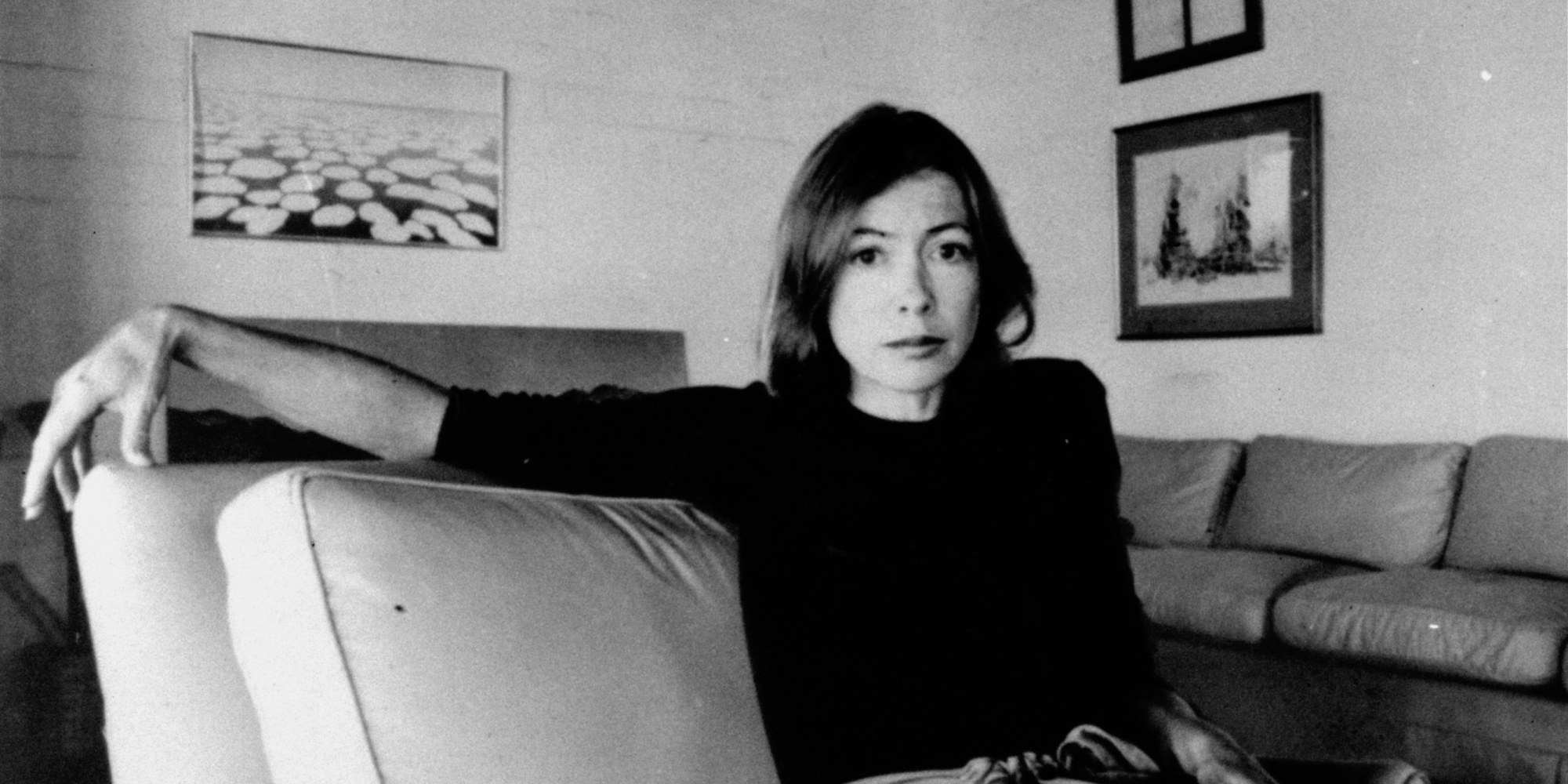
Joan Didion was born on December 5th, 1934, in Sacramento, California. A descendant of a member of the Donner Party, Didion felt deeply connected to California, taking "pride in the fact that the land on which she lived had belonged to her family for five generations," (Henderson). She came from a very conservative background, writing in Slouching Towards Bethlehem (the title of which was taken from the W.B. Yeats poem), "This is the California where it is easy to Dial-A-Devotion, but hard to buy a book," (Didion). She was interested in writing from a young age, writing stories about dark themes for a young girl, her first story being about a woman who dreamt she was freezing to death, only to wake up to find she was dying of heat on the Sahara Desert - this was written when she was five. Later, she would name her greatest writing influences to be authors such as Geroge Eliot and Henry James, but it would be Ernest Hemingway to make the greatest impact. Didion took a lot from his writing, stating “I learned a lot about how a short sentence worked in a paragraph, how a long sentence worked… how every word had to matter.” Throughout her childhood, Didion grew up in a gloomy environment. Her father served in WWII, so the family was moving around the country constantly. In her collection of essays titled Where I Was From¸ Didion writes “We lived in dark houses… and favored, a preference so definite that it passed as a test of character, copper and brass that had darkened and greened. We also let our silver darken, which was said to ‘bring out the pattern.’” While majoring in English at UC Berkley, Didion entered an essay contest sponsored by Vogue in 1956. She won the contest, winning the prize of getting a job writing for the magazine, leading her to move to New York City. She lived there for eight years, moving back to California in 1964 after getting married to writer John Dunne. By this time, Didion had already established herself as a journalist, gaining notoriety as she became one of the pioneers of New Journalism.

New Journalism was introduced in the 60s as a style of journalism that uses “non-traditional” literary techniques, making pieces seem more like short stories rather than news articles. New Journalism was meant to be “an alternative to more standard media renderings of social reality, promising to deliver a ‘more real’ reality, the truer story of the main social crises splitting American society in the sixties. For it was not only a loss of interest in fiction that engendered the search for a new style. It was, probably even more significantly, precisely the atmosphere of social crisis that had begun to make the traditional media seem so suspect and that had called attention to the way the media’s claim to be ‘objective’ was frequently a smokescreen for bias,” (Staub). In short, writers were looking for a way to tell news in a way that was by the people, for the people. Instead of writing about events from the outside looking in, New Journalists inserted themselves into the narrative and reported on the story from the inside. Hunter S. Thompson for example, wanted to write about Hells Angels- so he joined them. Literary techniques were used as a method of keeping the reader engaged through “including vivid descriptions of scenes and full conversations in dialogue, rather than short questions from one witness at a time,” (Worthington). Writers would also write from a “character’s” point of view, looking through the lens of the subject rather than that of the journalist. However, New Journalism didn’t come without its objections. Critics believed that shifting perspective between the journalist and the subject was “irresponsible and misleading… for it is highly debatable whether one could label as ‘nonfiction’ the depiction of the inner workings of another person’s mind,” (Worthington). Another criticism was the fact that the journalist or narrator was put in the center of the story. This never happened in traditional journalism, where reporters made sure to remove themselves from the story entirely to write objectively. 

The criticism was received, but New Journalists stood their ground: Many people during this time engaged in the social and political changes going on in America, and out of it all came fiction writers finding themselves “turning to the ‘rising authority of nonfiction’ to help make sense of the ‘fast-paced…apocalyptic’ times they were living in,” (Staub). Notable New Journalists include Tom Wolfe, Hunter S. Thompson, and Truman Capote, all writing about topics such as the Black Panthers, the war in Vietnam, and other political issues. Wolfe believed that “only literary journalism could convey the intense social impact of contemporary American life,” (Worthington). For Didion, New Journalism provided a different route. She wrote about a wide range of topics from Jim Morrison and the rise of shopping malls to the women’s liberation movement and Nancy Reagan, each time adding her own opinion or perspective on the subject. She was also “uncannily attuned to the dark undercurrents of the day- the social fractures and divides that fueled carelessness and alienation,” (Kakautani), for what separated her from others was the fact that she “was able to see the long-term stakes of this rupture at a moment when most observers were fretting over whether to don love beads or to follow draft cards,” (Heller). One example of this would be her 1972 essay, “The Women’s Movement.” 

The women’s liberation movement was the second wave of feminism that emerged in the 1960s. Their goal was towards equality for women, challenging the oppressive systems put in place. Nowadays, Joan Didion can be aligned with many feminist ideals, although she never considered herself a feminist. She especially disagreed with the women’s liberation movement, voicing her concerns in the 9th essay of The White Album. She brings up many different points in her essay, but one of the main ones is a lack of intersectionality: 

One oppressed class after another had seemed finally to miss the point. The have-nots, it turned out, aspired mainly to having. The minorities seemed to promise more, but finally disappointed: it developed that they actually cared about the issues, that they have tended to see the integration of the luncheonette and the seat in the front of the bus as real goals, and only rarely as ploys, counters in a larger game. They resisted that essential inductive leap from the immediate reform to the social ideal, and, just as disappointingly, they failed to perceive their common cause with other minorities, continued to exhibit a self-interest disconcerting in the extreme to organizers steeped in the rhetoric of “brotherhood.” (Didion, The White Album)

Almost twenty years before the term “intersectionality” was even coined, Didion was already pointing it out, able to look at the bigger picture. Her problem was with the superficialness of the movement. She thought it lacked depth, was becoming trivialized. She was “generally skeptical of progressive movements headed by white people… White activists are able to pick and choose their outrage, able to try on causes and identities with little investment, like picking something from a catalogue,” (Williams). Didion knew that the movement couldn’t focus on just white women, they had to take into consideration the differences that women of different races go through.  

Other than commentary on political issues and figures, Didion’s writing included many pieces on American life and culture. Didion viewed the 60s as a very chaotic time, feelings which can be seen in many of her essays from that time. The opening lines to her essay “Slouching Towards Bethlehem” is a striking example:

The center was not holding. It was a country of bankruptcy notices and public-auction announcements and commonplace reports of casual killings and misplaced children and abandoned homes… People were missing. Children were missing. Parents were missing. Those left behind filed desultory missing-persons reports, then moved on themselves. It was not a country in open revolution. It was not a country under enemy siege. It was the United States of America in cold late spring of 1967. (Didion, Slouching…)

 For a decade that saw the Vietnam war, the civil rights movement, protests, and political assassinations, it’s no surprise Didion would have these feelings about the America. Her essay goes on to report on the lives of a couple of hippies living in California. Hippies in the 60s were mainly young people from middle class white families. The stories she tells following this are not necessarily happy ones. She spends a couple days with the people she’s writing about, documenting their days, most of which are spent on drugs:

At three-thirty that afternoon Max, Tom, and Sharon placed tabs under their tongues and sat down together in the living room to wait for the flash. Barbara stayed in the bedroom, smoking hash. During the next four hours a window banged once in Barbara’s room, and about five-thirty some children had a fight on the street. A curtain billowed in the afternoon wind. A cat scratched a beagle in Sharon’s lap. Except for the sitar music on the stereo there was no other sound or movement until seven thirty, when Max said ‘Wow.’ (Didion, Slouching…)

Didion, like other New Journalists, is inserting herself into the story. She is there, she is experiencing it, she is writing a firsthand account. There were a wide range of thoughts and opinions on hippies in the 60s. Among the more critical ones were people who opposed the sex, drugs, and music they engaged in. Common stereotypes included laziness, dirtiness, and irresponsibility, and Didion’s characters aren’t exactly disproving the point. Among the hippie’s Didion is observing is a woman named Barbara, who “will take a part-time job, modeling or teaching kindergarten, but she dislikes earning more than ten or twenty dollars a week,” (Didion, Slouching…). Farther along the essay, Didion starts to make a discovery, one which Katherine Henderson is able to explain perfectly:

The climax of “Slouching Towards Bethlehem” is the reader’s realization that all of the hippies are emotionally stunted; they are essentially children playing at being grown-ups. They fulfill their most elemental needs- for food, companionship, and sexual release- but they avoid all the complexities of adult life: the need to find work that is rewarding and productive, the enduring commitment to another person, the search for words to communicate profound and intricate feeling… More surprising, the many reporters and photographers whom Didion meets in the district understand no better than the policemen. They were determined to assign the “hippie movement” some meaning in history, whether “artistic avant-garde” or “thoughtful protest”; they failed to see that these children were living without memory of plans, outside of time. “(Henderson).

And many of them were really children. Another one of the girls featured in the essay is only 17, a teenager, just like many other hippies at the time. But why so young? Many hippies would probably blame society for being too materialistic, too repressive. As for Didion, she puts blame entirely on her generation:

We were seeing the desperate attempt of a handful of pathetically unequipped children to create a community in a social vacuum… This was not a traditional generational rebellion. At some point between 1945 and 1967 we had somehow neglected to tell these children the rules of the game we happened to be playing. Maybe we had stopped believing in the rules ourselves, maybe we were having a failure of nerve about the game… They feed back exactly what is given them,” (Didion, Slouching…).

Documents such as this are so important for history. Through these accounts, we get a new understanding of the past, and new perspectives on people and cultures. Didion was able to do this perfectly by focusing on “smaller” topics such as hippies or Joan Baez, rather than larger more general ideas about America.

Despite all her talent and praise, Didion did receive some criticism. Despite the basic critiques New Journalism had received in general, her essay “The Women’s Movement” can be seen as anti-feminist or anti-woman for the way it criticized the movement. However, Didion isn’t attacking the core idea and values of the movement, but rather how the movement had manifested itself, as mentioned before. She never once denies what it’s like to be a woman, in fact, she describes it as the “sense of living one’s deepest life underwater, that dark involvement with blood and birth and death,” (Didion, The White Album). For most of her life, Didion was a conservative, which already is a put off for many people. She had a conservative upbringing being from old California and held conservative ideals until her later life when she started to become more liberal. However, her conservatism isn’t necessarily what one might picture as a typical conservative. To Didion, conservatism is “an intelligently expressed distaste for willful ignorance, or as she put it, ‘agonized complacency,’” (Zhang), a sentiment we can see in “Slouching towards Bethlehem,” with her criticism against the hippies she was writing about. As for general nitpicking on her writing, some say that “the peppering of her prose with proper nouns… is somehow unserious. (For whatever reason, these complains usually come from men,” (Heller). Others say that “of the later Didion that she has become in some ways a caricature of her earlier self, that her style has degenerated into parody. The sentences have gotten longer, they say, and more arch, and the stylistic mannerisms that so defined the early work have by now become cliches,” (Lacy). But whatever the criticism, there’s no doubt that Didion’s writing, and Didion herself, leave behind an important legacy.

Part of what makes Didion’s work last is the fact that it’s timeless. She saw the social “disorder” in society that still exists today. We see this once again in “Slouching Towards Bethlehem,” when she writes that the “center was not holding.” One could’ve applied this phrase to 3 years ago, when everyone was under lockdown due to Covid-19. The phrase can be applied to today, with news of global warming and wars and so much more bringing about feelings of uncertainty, or “the jitters,” as Didion called it. A certain college student could even use this phrase in her own life, as she rushes to finish papers and study for finals- it feels like the center could fall apart at any second. It’s easy to see our own world in her work, which “tragically, if unwittingly, anticipates our bewildered, agitated and insolubly divided culture, where the void she stared into so unflinchingly has become the climate in which we live,” (Merkin). Didion believed in thinking for yourself, for being educated and honest and willing to grow. She believed that “no one has the answers, and we must come to our own conclusions as intelligent beings with agency but also humility,” (Zhang). Through her writing, Didion has become a huge inspiration to many. Just as Hemingway taught her, Didion’s been an example and a teacher to many writers on how to write sentences, how to write paragraphs, how to write as if the center is not holding. And the inspiration doesn’t just stop at her writing. Despite not being a self-proclaimed feminist, many people look to her as one. For one, she was a woman breaking through a male dominated field throughout the 50s and 60s. Looking back on the past, “it must be hard for a young woman today to imagine the sheer scope of things that women of my generation feared women couldn’t do- but, believe me, writing with authority was one of them… [Didion] became Exhibit A… she gave you confidence. She shored you up. And did so not by rejecting the supposed realm of women, but by drilling down into it,” (Smith). The reason why we can’t imagine how different things were is because of women like Didion, who paved the way for other women writers and journalists to make their own mark. Even through all the praise, through all the writings and profound analyses of society, at the core of it all Didion is just a person. She had her struggles just like everyone else. She wrote about her migraines. She wrote about her grief after she lost her husband and daughter. She wrote about where she came from and where she lived, and she did it so well that people listened. Didion can be a writer for everyone, she’s become “a symbol of pioneering feminism despite her clash with the women’s movement, a liberal darling despite her conservative roots, a symbol of fidelity despite her tempestuous relationship with her husband and a sort of grief counselor,” (Nagourney). She was a mother and a wife and a woman, a writer whose work has stood the test of time and continues to inspire many. She lived through the chaos of the 60s and made it through to the 70s, when she gave an interview which only made her seem even more profound, that she even spoke diligently, not just in writing. She said “the finest hour had passed, I mean that, if the final test of your character was whether or not you could push on, get through the mountains, go on, if there was nowhere else to go then you were never gonna be put to that character test.,” (Didion, 1971). Didion knew that pain and struggle was a part of growing, a part of changing and becoming better. Seems like she knew it all, from the fragmentations of society to the fragmentation of oneself; if the center is not holding, push on. 


Works Cited

Center. (2021). Joan Didion, 1971. In YouTube. https://www.youtube.com/watch?v=bI8VR_P74Vw

Didion, J. (1968). Slouching Towards Bethlehem. Farrar, Straus and Giroux.
Didion, J. (1979). The white album. Simon & Schuster.

Heller, N. (2021, December 23). What Joan Didion Saw. The New Yorker. https://www.newyorker.com/magazine/2022/01/03/what-joan-didion-saw

Henderson, K. U. (1981). Joan Didion. Frederick Ungar Publishing Co.

Kakutani, M. (2021, December 24). Didion’s Prophetic Eye on America. The New York Times. https://www.nytimes.com/2021/12/24/opinion/joan-didion-books.html

Lacy, R. (2014). Joan Didion Daughter of Old California. The Sewanee Review, 122(3), 500–505. https://www.jstor.org/stable/43662887?seq=5

Merkin, D. (2022, January 20). The Cult of Saint Joan. The New York Times. https://www.nytimes.com/2022/01/20/books/review/reckoning-with-joan-didion-the-archpriestess-of-cool.html
Nagourney, A. (2022, October 6). Joan Didion and the Western Spirit. The New York Times. https://www.nytimes.com/2022/10/06/arts/design/joan-didion-hammer-museum-hilton-als.html

Smith, Z. (2021, December 24). Joan Didion and the Opposite of Magical Thinking. The New Yorker. https://www.newyorker.com/culture/postscript/joan-didion-and-the-opposite-of-magical-thinking

Staub, M. E. (1997). Black Panthers, New Journalism, and the Rewriting of the Sixties. Representations, 57, 52–72. https://doi.org/10.2307/2928663

Williams, K. (2016, February 7). Close Reading: Joan Didion’s “The Women’s Movement” |. Evergreen State College. https://sites.evergreen.edu/eyeofthestory/close-reading-joan-didions-the-womens-movement/

Worthington, M. (2018). The Story of “Me”: Contemporary American Autofiction. In JSTOR. University of Nebraska Press. https://www.jstor.org/stable/j.ctv7fmfvx.7

Zhang, A. (2022, February 17). Why You Should Read Joan Didion’s Writing. The UNISVerse. https://theunisverse.com/2338/showcase/why-you-should-read-joan-didions-writing/#:~:text=Didion


Feminism in Fashion

 Feminism in Fashion

Sloan


Fashion throughout time has tackled the topic of femininity and the sexualization of women. It's shown through different ways, whether one chooses to embrace masculinity or femininity itself, fashion means representation and the construction of identity. Fashion has been very important to feminism since the 1920s, since "Feminism, as we know, produced an important vocabulary for discussing the ways in which representations of the female body construct femininity. If we see women's fashion as a field of representations of the female body then it becomes a significant text of how culture constructs femininity and how it addresses that representation to women," (Evans, Thornton). It's important to understand how femininity has been seen or defined throughout history. For the most part, masculinity was the norm, while femininity was something different than the norm. Fashion early on was important because it gave women access to expression that's been notoriously denied to them by the men dominating the fine art world.

Let's look at two examples from the 1920s. Coco Chanel and Elsa Schiaparelli both challenged
traditional gender norms at the time, with Chanel grabbing inspiration from masculinity while Schiaparelli "embraces the decorative, the superfluous and the nonfunctional in a repudiation of the restrictions of the masculine dress which Chanel adopted to signify control," (Evans, Thornton). Chanel was able to popularize pants as a fashion staple, when they were worn almost exclusively by men. Jersey, the fabric used mainly to make men's underwear, was a favorite of Chanel and was used in many of her dresses. Chanel's main point was that she "wanted women to move and breathe in her clothes, just like men did in theirs," (Cerini). Schiaparelli, on the other hand, embraced femininity and the idea of vulnerability. Her most famous peace, the Tears dress, uses a pattern designed by Salvador Dali. The piece plays with the idea of the body's vulnerability, as the pattern features "rips" or tears. This almost violent imagery is "counter imposed by the elegance of the dress, its existence as sophisticated fashion, the fact that it is not rags, not torn... Violence and eroticism are simultaneously displayed and made to disappear, beauty is brought to bear on rupture," (Evans,               Thornton). The significance of Schiaparelli associating her work with Surrealism is that it brings a psychoanalytical perspective to the piece. In Surrealism, there is a concern with how sexuality is shown through feminine representations that were often eroticized, as well as being a play on appearances, and a discussion of illusion. Schiaparelli was eager to explore these themes, and her "approach to dress centers around an understanding of how it acts simultaneously to repress the body and to bring it into the realm of language- the symbolic," (Evans, Thornton).

Even Vivienne Westwood in the 80s had her own take on feminine expression. She believed that femininity was determined by the woman herself, and the idea that they have full control over their own self expression. Her clothing focused on issues regarding women's bodies, sexualities, and identity. Her punk collection promotes the idea of self expression and challenges sexual messages. With her influence, "Bondage dress allowed women to express the crudest will to sexual power... they looked like prostitutes but were not. They were women but were not 'feminine,'" (Evans, Thornton). These ideas were a display of power - not of what could be done, but of what could be signified. Westwood's mini-crini from 1986 was a cross between the 19th century's crinoline, and the more modern mini skirt. It was meant to represent history's constantly changing definition of the female body. In the 19th century, crinoline designs were drawn on women with overly exaggerated hips, a sign of the time where child bearing was of great importance. Westwood believed "Femininity is stronger... At my age I'd rather have a bit of flab, I actually think that's more sexy." To Westwood, "sexiness" was defined by the wearer. If the wearer thinks it's sexy, then it is. Her clothing was made outside the male definition, something which is "crucially, linked to our experiences of our bodies," (Evans, Thornton).


Feminist fashion doesn't just stop at designer fashion. The Women's Liberation movement started in
1968 with a protest outside the Miss America Pageant in Atlantic City. Women threw their bras, cosmetics, heels, and girdles alongside copies of Playboy and Cosmopolitan into a "Freedom Trash Can." They were angry at the current image of women and femininity. Women were being "regulated to menial tasks such as typing while men occupied decision-making rules but... men sexually objectified them." The American media was filled with images of women being sexualized and advertisements for cosmetic products were aimed towards men, encouraging them to expect women to fit into an idea of what a woman should look like. By playing up these fashions, the status of women as sexual objects was perpetuated, and this became the most basic form of oppression. Women were expected to look pretty, expected to act feminine, all while "ugly" women were "scarce because they [were] actively discouraged," (Hillman). To combat this, many women cut their hair, or stopped shaving their legs and armpits. Lesbian feminist Colletta Reid stated, "Female clothing, just like feminist hair styles... are all aimed at making the differences between men and women readily apparent. If men and women dressed and acted alike... how would men know who to treat as inferior, who to hire as secretaries, who to rape?" By cutting their hair, women were symbolically cutting themselves off from the patriarchal standards of feminine beauty. They were rejecting the idea that their identities were tied to femininity, because as one feminist stated in 1968, "no woman can be free, as a person, until she loses her femininity."


Works Cited

Cerini, Marianna, "How Coco Chanel Changed the Course of Women's Fashion." CNN, 9 Jan, 2021, www.cnn.com/style/article/coco-chanel-fashion-50-years/index.html

Evans, Caroline, and Minna Thornton. "Fashion, Representation, Femininity." Feminist Review, vol. 38, 1991, p.48, https://doi.org/10.2307/1395377

Luther Hillman, Betty. ""The Clothes I Wear Help Me to Know My Own Power": the Politics of Gender Presentation in the Era of Women's Liberation." Frontiers: A Journal of Women Studies, vol. 34, no. 2, 2013, p.155, https.doi.org/10.5250/fromjwomenstud.34.2.0155


Tuesday, February 13, 2024

Feminism in Art: Rhythm 0


Feminism in Art
RHYTHM 0

Sloan


Performance art is described as a "time-based art form that typically features a live presentation to an audience or onlookers... and draws on art such as acting, poetry, music, dance, and painting" (Britannica). In the 60s and 70s, performance art was characterized by improvisation and spontaneity, audience interaction, and political agitation. It was meant to challenge traditional art conventions as a way to find a new audience or test new ideas. It soon became a favorite art form for feminist artists, one example being Serbian artist Marina Abramovic. In 1974, Abramovic created a group of performances as a part of her Rhythm series, in which she explored themes such as "control", the loss of it, and the limits of the human body," (Graf). Rhythm 0 was the last piece in her series, also regarded as her most dangerous one.

The performance took place in 1974. Abramovic gave her audience the following instructions:
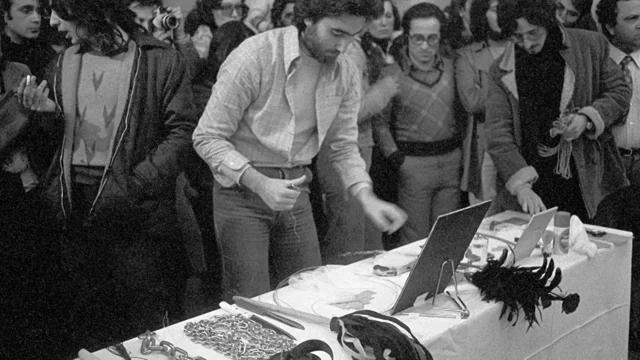
There are 72 objects on the table that one can use on me as desired
Performance:
I am the object.
During this period I take full responsibility.

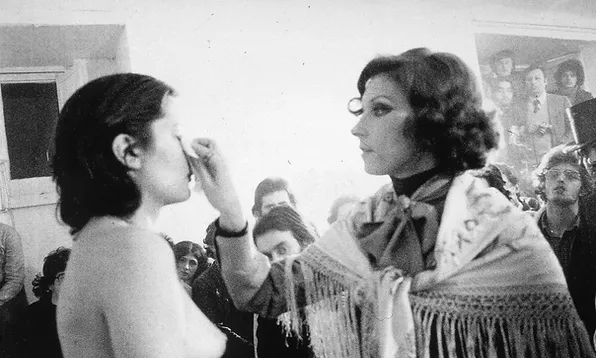
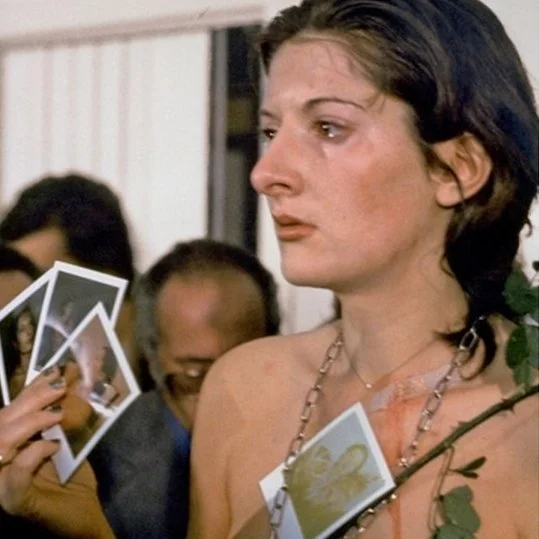
The performance was set to go on for six hours, in which Abramovic gave the audience full control over her body and the objects on the table. Amongst the 72 objects was a rose, polaroid camera, newspaper, red paint, a book, scissors, a kitchen knife, a gun, and a bullet. Abramovic gave the audience the opportunity and choice to use the objects in a way that was either pleasurable or harmful to her and intended to question the responsibility of whoever participated. The piece started off tame. Art critic Thomas McEvilley describes the events that took place, writing that "Someone turned her around. Another person thrust her arm into the air. Someone else touched her somewhat intimately." Although it is arguable whether being "touched intimately" could be considered tame or not, the events that followed got worse. Within an hour, all her clothes were cut off and she had been sexually assaulted. McEvilley went on to write how "When a loaded gun was thrust to Marina's head and her own finger was being worked around the trigger, a fight broke out between the audience fractions." Not every audience member participated in the violence, but not everyone intervened when someone else went too far. Although it's not clear if the performance ended because the 6 hours were over or because the audience eventually put a stop to it, we do know that the audience fled in the end out of fear of facing Abramovic. The piece questioned morality, as audience members did things they wouldn't normally do in real life. They were put int he uncomfortable position of deciding whether someone lives or dies, and the fact the audience fled after the performance shows they knew their actions were morally wrong. Whether they participated or not, audience members may have felt encouraged to commit acts of violence after hearing the initial instructions, and seeing the suggestive items on the table, indicating the ability for violence. After the performance, Abramovic says part of her hair had turned completely white, and she was covered with scars and the feeling of fear for a long time.


Abramovic herself stated she never thought of Rhythm 0 as a feminist piece, but these ideas show through her performance. Despite the fact that performance art was already seen as "attention-seeking, sensationalist, masochistic, and exhibitionistic," (Graf), Abramovic being a woman gives the piece a bigger impact. Women in the art world during the 70s were already prone to censorship. In the performance itself, Abramovic "wasn't too bad to look at" and that "someone might be able to use her." Abramovic herself stated she "never thought that it was female energy that drove the piece and that the courage to do this piece seemed more male from her point of view," (Graf). Regardless of what her initial intentions were regarding the message of the piece, we can still see feminist questions being asked. Would the performance have gone differently if Abramovic was a man? And how might the audience have acted if no one else was watching?

More from Rhythm 0


Works Cited


Graf, Stephanie. "Rhythm 0: A Scandalous Performance by Marina Abramovic." The collector, 29 June 2022, www.thecollector.com/rhythm-0-by-marina-abramovic/.

Wainwright, Lisa S. "Performance Art." Encyclopedia Britannica, 2019, www.britannica.com/art/performance-art.

Feminism in Music

Feminism in Music
RIOT GRRRL
Sloan

"Girlhood is not a universal component of female experience; rather, the term implies very specific practices and discourses about female sexuality, women's cultural-political agency, and women's social location." -Gaye Wald

The end of the 80s brought the start of a new music genre: grunge, or as the women in Olympia called
it, "cock rock." They viewed the scene as a sort of boys club, with many of them feeling unsafe and unwelcomed at shows. One of these women was Portland native Kathleen Hanna. After moving to Olympia, she opened a small music venue called Reko Muse, to serve as a place for small traveling bands to perform, since there wasn't any other place in the area. Unfortunately, this soon revealed how the punk rock scene truly was. "I did everything from painting the floor to cleaning the grease off the floor to wiping their stupid cock-rock graffiti off the wall after they left," she said, "and picking up their cigarette butts, and spending my own long-distance money to book their dumb bands into our own club, and then having them yell at me because there's not enough orange juice backstage." She was slowly getting tired of it all. She had loved music all her life, and being exposed to this line of rotating bands from hell was something that offended her. On top of managing the venue, Kathleen had an internship at a domestic violence shelter where she did crisis counseling along with presentations at high schools about rape and sexual assault. She would counsel girls about their past trauma, and started to talk to them after shows. She would listen to endless stories about abusive boyfriends and fathers, hear countless stories on the news about women being killed, attacked, and raped. After reading a Time article about women who didn't consider themselves feminists, Kathleen came to the conclusion that feminism could save people's lives. Around the same time Kathleen Hanna made this revelation, Alison Wolfe and Molly Neuman were working on one of the first Riot Grrrl zines. Zines were an important part of Riot Grrrl, as they were a way for girls to express themselves and their anger towards this music scene, or even just the world in general. As Kathleen Hanna would write in her Riot Grrrl manifesto, "BECAUSE I believe with my whoelheartbodymind that girls constitute a revolutionary soul force that can, and change the world for real." Soon enough, Kathleen went on to form her band Bikini Kill, while Alison and Molly formed their band Bratmobile. They would put a lot of focus on femininity and girlhood as a way to break stereotypes against women in the music industry. At their shows, Katheleen would write phrases on her body such as "slut" or "whore," in order to take away their power. If men at their shows saw her dancing around in her underwear, and see exactly what they're thinking written on her, all the power goes. She's reclaiming the word, saying, so I'm a slut? So what?"

"Such an emphasis on girliness has enabled women performers to preempt the sexually objectifying gaze of corporate rock culture, which tends to market women's sexual desirability at the expense of promoting their music or their legitimacy as artists," (Wald). Although not part of the Riot Grrrl movement herself, Gwen Stefani from No Doubt was breaking barriers in a similar way. Their song "I'm Just a Girl" was a the top of the charts in 1995, creating almost the same effect that Bikini Kill and Bratmobile were trying to achieve. "The strategy of approaching girlhood, like the word girl itself, signifies ambiguously: as a mode of culturally voiced resistance to patriarchal femininity; as a token of a sort of 'gestural feminism' that is complicit with the trivialization, marginalization, and eroticization of women within rock music cultures," (Wald). By celebrating and reclaiming girlhood, these bands were able to break long standing narratives within the traditionally male rock cultures. As Tobi Vail of Bikini Kill wrote in her zine Jigsaw, "Of course if there was ever a good girl band... and they were a BAND... in the top 40 of course it would be likely to get a bad name... because girls +guitars is equal to sex +power."

The Riot Grrrl movement started to falter in the late 90s, as many women felt that mainstream media had entirely misinterpreted their message. Even though they were looking for equality - not superiority. USA today had published an article about the movement saying, "Better watch out boys. From hundreds of once pink, frilly bedrooms, comes the young feminist revolution. And it's not pretty. But it doesn't wanna be. So there!" Riot Grrrls weren't being taken seriously. They were seen as "man haters," teen gangsters, and self-absorbed. Corin Tucker of Heavens to Betsy and Sleater-Kinney said, "I think it was deliberate that we were made to look like we were just ridiculous girls parading around in our underwear. They refused to do serious interviews with us, they misprinted what we had to say, they would take our articles, and our fanzines, and our essays and take them out of context. We wrote a lot about sexual abuse and sexual assault for teenagers and young women. I think those are really important concepts that the media never addressed." Another way the movement failed was not being able to discuss feminism through an intersectional lens. Although there were Riot Grrrls of color in places such as California and New York, they didn't get as much focus or attention as their white counterparts. Riot Grrrl as we knew it isn't around today, but there are still women who continue to spread their message through zines and music. Many women of color sell their own zines on site such as Etsy. Though small, Riot Grrrl is still alive, as there is still a lot to be changed, and there is still a lot to fight for.